
As India’s single-use plastic ban enters its full enforcement phase in 2026, businesses face mounting pressure to eliminate carry bags and packaging from their downstream supply chains. With fines up to ₹1 lakh per violation and stricter BRSR reporting requirements, non-compliance isn’t just costly—it’s a reputational risk.
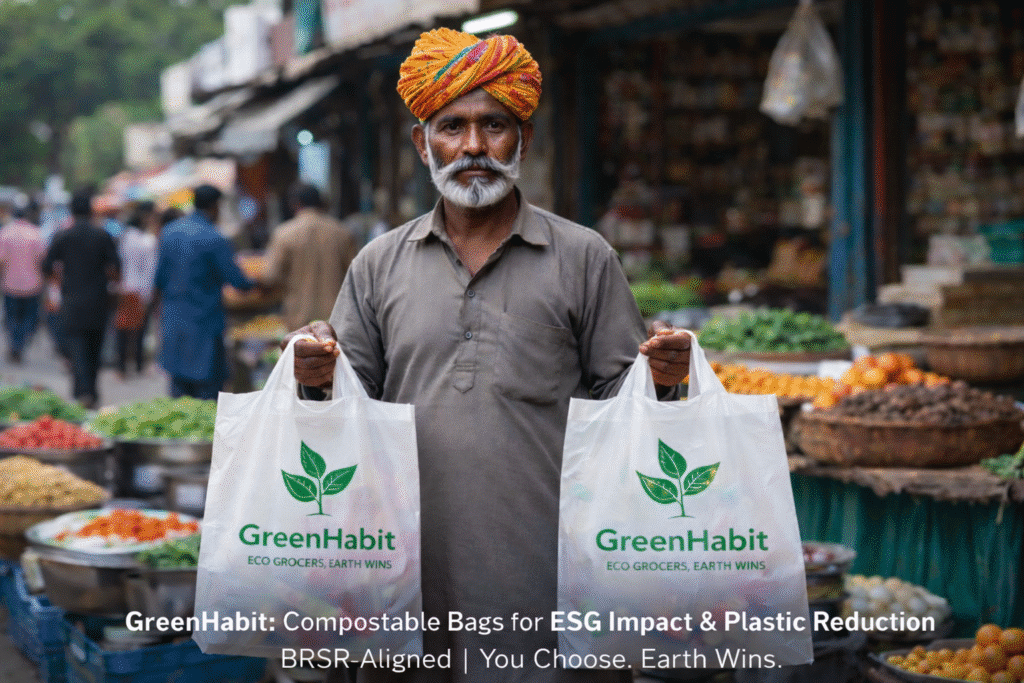
But here’s the good news: compliance can be simple, affordable, and even a strategic ESG win. At GreenHabit, we’re making it happen through innovative sponsorships of compostable carry bags.
The 2026 Plastic Ban Challenge: What Businesses Need to Know
The Plastic Waste Management Rules, 2022 (amended in 2024), ban carry bags thinner than 120 microns and extend producer responsibility to downstream waste. For FMCG, retail, and consumer brands, this means:
- Vendor Fines: Street vendors (your distribution network) are hit hardest, disrupting sales and goodwill.
- Scope 3 Emissions: Packaging contributes 30-40% of downstream emissions—now a key BRSR Principle 6 focus.
- Verification Gaps: Many “alternatives” (thicker plastics or untested “biodegradable” bags) fail CPCB audits, leading to greenwashing accusations.
Common pitfalls include switching to non-compliant “eco” bags or ignoring vendor education, resulting in black markets or continued plastic use. The solution? A scalable, verifiable alternative that empowers vendors while delivering measurable impact for your reports.
GreenHabit’s Zero-Risk Compliance Solution: Compostable Bag Sponsorships
GreenHabit turns compliance into opportunity. We sponsor 100% plant-based, CPCB-registered compostable carry bags for Uttar Pradesh street vendors—free for them, branded for you.
Our bags are made from 70-80% cornstarch with natural polymers, fully decomposing in 90-180 days into CO₂, water, and biomass (no microplastics). They’re BIS/IS 17088 certified, food-contact safe (FSSAI compliant), and load-tested to 10-12 kg.
How It Works:
- Sponsorship Model: Brands fund bags (Starter: 10,000/month, ~₹50,000) – we handle production, printing, and distribution.
- Vendor Empowerment: Free bags keep vendors compliant, avoiding fines and supporting livelihoods.
- Your Wins: Hyper-local branding (5-50 lakh impressions/month) + ESG metrics (plastic diverted, CO₂e avoided).
Download our full Material Specifications PDF for technical details, including certifications and decomposition data.
Benefits: Compliance, Impact, and ROI
- Legal Compliance: Fully aligned with 2026 ban rules—no fines, no audits.
- Verifiable Metrics: Geo-tagged delivery proof, signed certificates, and monthly reports for BRSR filings (e.g., 5 tonnes plastic diverted = ~15 tonnes CO₂e saved per 25,000 bags).
- Cost-Effective: Lower than digital ads, with tangible CSR storytelling.
- Scalable: Start small, expand to other states.
Early pilots show 20% improvement in brand perception among eco-conscious consumers, plus community uplift (vendors report 15% sales boost from reliable packaging).
5 Steps to Plastic Ban Compliance in 2026
- Assess Your Gap: Review downstream packaging in BRSR Scope 3.
- Choose a Pilot: Start with GreenHabit’s Starter package (10,000 bags).
- Customize & Launch: Add your branding; we distribute in high-traffic UP markets.
- Track Impact: Receive real-time metrics and proof.
- Report & Scale: Integrate into ESG reports; expand for full compliance.
Ready to Lead on Compliance?
The 2026 ban isn’t a hurdle—it’s your chance to demonstrate leadership in circular economy.
Book a 15-minute demo to get a personalized compliance preview.
GreenHabit – You Choose. Earth Wins.